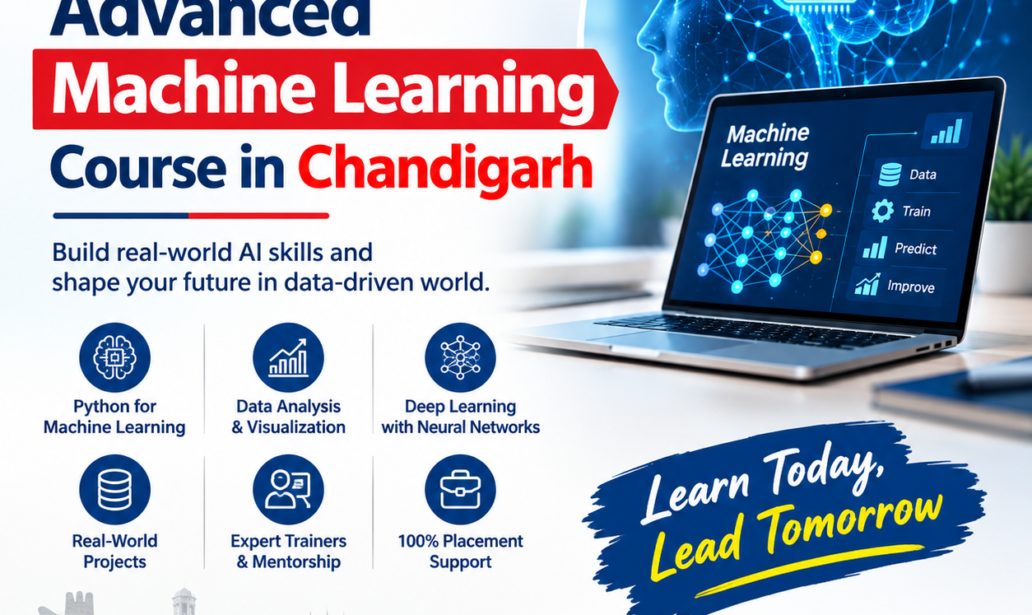
Machine Learning has become one of the most important technologies in the modern IT industry. From recommendation systems and predictive analytics to automation, fraud detection, computer vision, and intelligent applications, Machine Learning is being used across different industries. For students, developers, data professionals, and working professionals who want to build advanced skills, choosing the right Advanced Machine Learning Course in Chandigarh can provide a structured path toward understanding intelligent systems and practical ML applications.
CBitss offers Machine Learning training in Chandigarh with a practical learning approach that covers fundamental concepts as well as advanced areas such as model evaluation, feature engineering, deep learning, model deployment, explainable AI, and model interpretation. The course information published by CBitss also highlights Python, Scikit-learn, Pandas, NumPy, Matplotlib, Jupyter Notebook, and advanced tools such as TensorFlow and Keras.
What Is Advanced Machine Learning?
Advanced Machine Learning goes beyond learning basic algorithms. It focuses on understanding how models are designed, optimized, evaluated, interpreted, and applied to real-world datasets.
While beginners may start with concepts such as regression, classification, and clustering, advanced learners can progress toward feature engineering, hyperparameter optimization, ensemble methods, neural networks, deep learning, model deployment, and explainable AI.
The goal of advanced training is not simply to run an algorithm. Learners should understand the complete machine learning workflow—from collecting and preparing data to training models, evaluating results, improving performance, and applying models to practical problems.
Why Learn Machine Learning in Chandigarh?
Chandigarh and the surrounding Tricity region have a growing technology and education ecosystem. Learning locally can provide students and professionals with access to classroom training, instructor guidance, practical assignments, and flexible learning options.
CBitss provides Machine Learning training through online, offline, and hybrid modes. Its published course information lists weekday and weekend options, making the program suitable for students as well as working professionals.
For learners who prefer classroom interaction, training at the CBitss Chandigarh location can provide direct instructor support. Those who need greater flexibility can explore online or hybrid learning options.
Advanced Machine Learning Course Curriculum
A well-structured Advanced Machine Learning Course in Chandigarh should cover both mathematical concepts and practical implementation. At CBitss, the published Machine Learning curriculum includes areas such as supervised learning, unsupervised learning, data preprocessing, feature engineering, model evaluation, and deep learning fundamentals.
1. Python for Machine Learning
Python is widely used for data analysis and machine learning projects. Students can learn how to work with Python syntax, functions, data structures, and libraries used in ML workflows.
Important tools include:
- NumPy
- Pandas
- Matplotlib
- Scikit-learn
- Jupyter Notebook
These tools help learners prepare datasets, perform analysis, visualize information, train models, and evaluate results.
2. Data Preprocessing
Quality data is essential for building useful machine learning models. Advanced training covers methods for cleaning and preparing datasets before model development.
Topics can include:
- Handling missing values
- Removing duplicate data
- Data transformation
- Data scaling
- Normalization
- Encoding categorical variables
- Outlier handling
Proper preprocessing can help create more consistent datasets for machine learning experiments.
3. Supervised Learning
Supervised learning uses labelled datasets to train models for prediction or classification.
Learners can explore algorithms such as:
- Linear Regression
- Logistic Regression
- Decision Trees
- Random Forest
- Support Vector Machines
- K-Nearest Neighbors
- Ensemble methods
Students can apply these algorithms to practical datasets and compare their performance.
4. Unsupervised Learning
Unsupervised learning is useful when datasets do not contain predefined labels. Instead, algorithms can be used to identify patterns or groups within the data.
Important topics include clustering and dimensionality reduction. Learners can explore techniques such as K-Means and related approaches for discovering hidden structures in datasets.
5. Feature Engineering
Feature engineering is an important part of advanced machine learning. It involves transforming existing data or creating useful features that can help a model identify meaningful patterns.
Students can learn how to select relevant variables, transform data, create derived features, and reduce unnecessary information.
Good feature engineering can make a significant difference when developing predictive models.
6. Model Evaluation and Validation
Building a model is only one part of the machine learning process. Learners also need to determine how well the model performs.
An advanced course can introduce:
- Training and testing datasets
- Cross-validation
- Accuracy
- Precision
- Recall
- F1-score
- Confusion matrix
- Regression evaluation metrics
CBitss specifically lists model evaluation and validation among the areas included in its Machine Learning curriculum.
7. Hyperparameter Optimization
Different machine learning algorithms contain parameters that influence how they learn. Advanced learners can understand how to tune these parameters to improve model performance.
Techniques such as grid search and other optimization approaches can be used to compare different configurations.
This helps learners move from simply using default algorithm settings toward developing more carefully optimized models.
8. Deep Learning and Neural Networks
Deep Learning is an important advanced area of Artificial Intelligence and Machine Learning. Neural networks can be used for complex problems involving images, text, audio, and other forms of data.
CBitss includes Deep Learning fundamentals within its Machine Learning course information, while its AI course also covers advanced areas including neural networks and reinforcement learning.
Learners interested in deep learning can progress toward concepts such as:
- Neural network architecture
- Activation functions
- Training neural networks
- Loss functions
- Optimization
- TensorFlow
- Keras
Practical Machine Learning Projects
Practical projects are an important part of advanced training because they allow learners to apply theoretical concepts to real datasets.
A project-based learning approach can involve building models for:
- Customer prediction
- Sales forecasting
- Classification problems
- Customer segmentation
- Recommendation systems
- Fraud detection
- Sentiment analysis
- Image classification
Working on projects also helps students understand the complete workflow of a machine learning application rather than studying algorithms separately.
Model Deployment and Real-World Applications
Advanced Machine Learning is not limited to training models inside a notebook. In professional environments, models may need to be integrated into applications and business workflows.
Model deployment introduces learners to the process of making trained models available for practical use. Depending on the learning path, students may explore APIs, application integration, cloud platforms, monitoring, and model maintenance.
CBitss describes its advanced Machine Learning learning path as including model deployment, capstone projects, explainable AI, and model interpretability.
Explainable AI and Model Interpretability
As machine learning systems become more complex, understanding why a model produces a particular prediction becomes increasingly important.
Explainable AI focuses on making model decisions easier to understand. Students can learn why interpretability matters and explore methods for analyzing model predictions.
This knowledge can be especially useful when machine learning is applied in areas where users and organizations need greater transparency around automated decisions.
Who Can Join an Advanced Machine Learning Course?
An advanced Machine Learning program can be useful for a variety of learners, including:
- Computer science students
- Python developers
- Data analysts
- Software developers
- Data science learners
- AI enthusiasts
- IT professionals
- Working professionals planning a career transition
A basic understanding of programming, mathematics, statistics, and Python can make advanced concepts easier to understand. However, learners can also build these foundations progressively through structured training.
Career Applications of Machine Learning
Machine Learning skills can be applied across technology, finance, healthcare, retail, marketing, manufacturing, cybersecurity, and other sectors.
Depending on their education and experience, learners can explore career paths such as:
- Machine Learning Engineer
- Data Scientist
- AI Engineer
- Data Analyst
- Python Developer
- Business Intelligence Professional
- Research Assistant
- AI/ML Developer
The exact role and career path depend on an individual’s technical background, project experience, specialization, and broader professional qualifications.
Why Choose CBitss for Advanced Machine Learning Training?
CBitss states that it has more than two decades of experience in IT training and offers its Machine Learning program through online, offline, and hybrid modes. Its published course details also mention practical assignments, live projects, industry-focused learning, and flexible weekday or weekend batches.
The institute’s Machine Learning curriculum combines programming, data preparation, algorithms, model evaluation, deep learning fundamentals, and advanced machine learning concepts. This creates a structured learning path for people who want to progress from basic ML knowledge toward more advanced applications.
CBitss is located at SCO 23-24-25, Level 3, Sector 34-A, Chandigarh, and its published contact number is 9988741983.
Start Learning Advanced Machine Learning
Machine Learning is a continuously developing field, and learning should go beyond memorizing algorithms. A strong learning path combines Python programming, data preprocessing, statistics, machine learning algorithms, model evaluation, feature engineering, deep learning, deployment, and practical projects.
If you are searching for an Advanced Machine Learning Course in Chandigarh, a structured program can help you build these skills step by step. With practical exercises, project-based learning, instructor guidance, and exposure to modern ML tools, learners can develop a stronger understanding of how intelligent systems are created and applied to real-world problems.
CBitss provides Machine Learning training with multiple learning modes and a curriculum that progresses from core ML concepts toward advanced areas such as deep learning, model deployment, explainable AI, and model interpretation.
CBitss – Machine Learning Training in Chandigarh
📞 9988741983