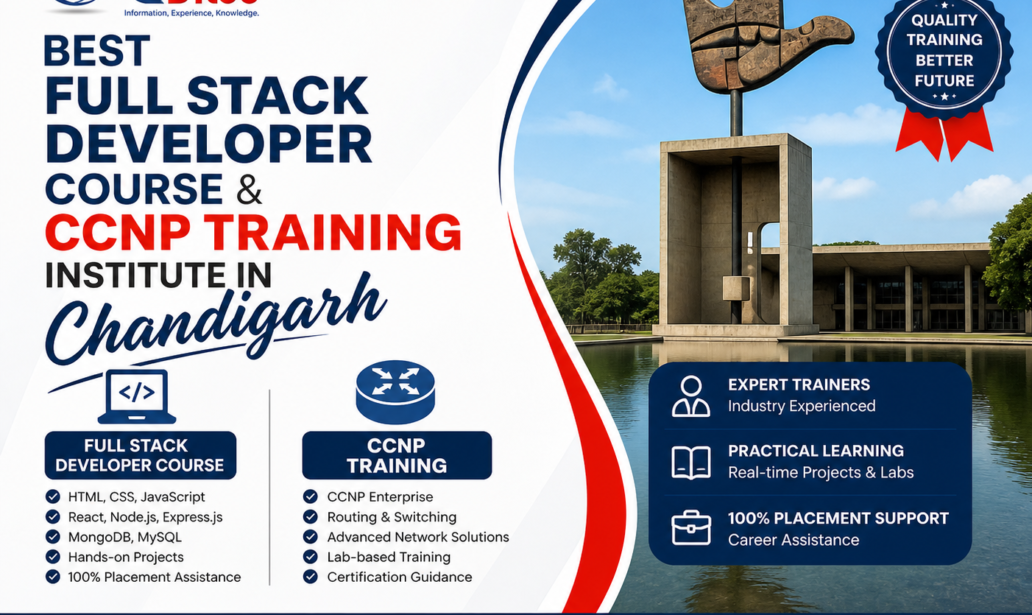
The demand for skilled web developers is growing as businesses increasingly depend on websites, web applications, e-commerce platforms, and digital services. If you want to build a career in web development, learning both front-end and back-end technologies can give you a strong foundation. A Full Stack Developer Course in Chandigarh is designed to help learners understand the complete process of developing modern web applications, from designing the user interface to managing databases and deploying applications.
A full stack development program generally combines technologies such as HTML, CSS, JavaScript, React, Node.js, Express.js, MongoDB, MySQL, and other development tools. The most valuable part of the learning process is not simply understanding programming concepts but applying them through practical projects and real-world development tasks.
What Is Full Stack Development?
Full stack development refers to the development of both the front end and back end of a web application.
The front end is the part of a website or application that users see and interact with. It includes layouts, buttons, forms, navigation menus, animations, and other visual elements.
The back end works behind the scenes. It manages server-side logic, databases, authentication, APIs, and communication between different components of an application.
A full stack developer understands how these different layers work together. This makes full stack development a useful career path for students, graduates, working professionals, and aspiring developers who want broader technical skills.
1. HTML – Building the Structure of Websites
HTML, or HyperText Markup Language, is one of the first technologies students learn in web development.
You will learn how to create the basic structure of web pages using headings, paragraphs, images, links, tables, forms, lists, and semantic elements.
Important HTML concepts include:
- HTML document structure
- Semantic HTML
- Forms and input fields
- Tables and lists
- Images and multimedia
- Links and navigation
- HTML5 elements
- Accessibility basics
A strong understanding of HTML helps developers create properly structured and user-friendly web pages.
2. CSS – Designing Attractive Interfaces
After learning HTML, CSS helps you style and design web pages. CSS controls colours, fonts, spacing, layouts, backgrounds, borders, and responsive designs.
During a full stack development program, learners can explore:
- CSS selectors
- Box model
- Flexbox
- CSS Grid
- Responsive design
- Media queries
- Animations and transitions
- Positioning
- Modern layout techniques
Responsive design is particularly important because websites need to work properly across desktops, tablets, and smartphones.
3. JavaScript – Adding Functionality
JavaScript is one of the most important technologies in modern web development. It allows developers to create interactive and dynamic websites.
Students can learn concepts such as variables, functions, arrays, objects, loops, conditions, events, DOM manipulation, and asynchronous programming.
Advanced JavaScript topics may include:
- ES6+ features
- Arrow functions
- Destructuring
- Promises
- Async/await
- APIs
- JSON
- Error handling
- Event handling
- Modules
Strong JavaScript knowledge makes it easier to work with modern frameworks and back-end technologies.
4. React – Developing Modern Front Ends
React is widely used for creating interactive user interfaces. In a Full Stack Developer Course in Chandigarh, learning React can help students move beyond basic HTML, CSS, and JavaScript development.
React training may cover:
- Components
- Props
- State
- Hooks
- Forms
- Event handling
- Conditional rendering
- React Router
- API integration
- Component-based architecture
Students can also learn how to build reusable components and manage data within applications.
5. Node.js – Learning Server-Side Development
Node.js allows developers to use JavaScript for server-side programming. It is an important part of many modern full stack development environments.
Learners can understand how to create servers, handle requests, work with files, manage packages, and develop back-end applications.
Key areas may include:
- Node.js fundamentals
- npm
- Modules
- File handling
- HTTP requests
- Server creation
- Asynchronous programming
- Error handling
- Environment configuration
Learning Node.js allows developers to work with JavaScript across both the front end and back end.
6. Express.js – Building Back-End Applications
Express.js is a popular Node.js framework used for developing web applications and APIs.
Students can learn how to create routes, handle requests and responses, use middleware, validate data, and connect applications with databases.
Practical learning may include creating:
- REST APIs
- Authentication systems
- User registration modules
- Login systems
- CRUD applications
- Backend services
Understanding Express.js helps learners develop the server-side functionality required by modern web applications.
7. MongoDB – Working with NoSQL Databases
A web application needs a reliable way to store and retrieve information. MongoDB is a popular NoSQL database used in many JavaScript-based development environments.
Students can learn:
- Databases and collections
- Documents
- CRUD operations
- Queries
- Data modelling
- Database connectivity
- Indexing basics
- MongoDB with Node.js
Practical database exercises can help students understand how application data is created, updated, retrieved, and deleted.
8. MySQL and Database Concepts
Along with NoSQL databases, understanding relational databases can be useful for aspiring developers. MySQL is commonly used for applications that require structured data and relationships between tables.
Learners may study:
- Tables
- Rows and columns
- Primary keys
- Foreign keys
- SQL queries
- Joins
- Database relationships
- Insert, update, delete, and select operations
Learning both relational and NoSQL database concepts can provide a broader understanding of application development.
9. APIs and Application Integration
Modern applications frequently communicate with other applications and services through APIs.
A good Full Stack Developer Course in Chandigarh should explain how APIs work and how front-end applications communicate with back-end servers.
Students can learn about:
- REST APIs
- HTTP methods
- GET, POST, PUT, and DELETE
- JSON data
- API requests
- API responses
- Authentication
- Third-party API integration
Practical API projects can make it easier for learners to understand how different components of a web application communicate.
10. Git and GitHub
Version control is an important professional skill for developers. Git helps developers track changes in their code and collaborate with other team members.
Students can learn commands and concepts such as:
- Git repositories
- Commits
- Branches
- Merging
- Pull requests
- GitHub repositories
- Collaboration
- Version management
These skills can also help students maintain projects and present their development work to potential employers.
11. Real-World Projects and Practical Training
Learning programming concepts is important, but practical implementation is equally valuable. A project-based approach allows learners to understand how different technologies work together.
Possible projects include:
- E-commerce websites
- Portfolio websites
- Blog platforms
- Online booking systems
- Student management systems
- Product management applications
- Authentication systems
- Business websites
Projects can help students develop problem-solving abilities and create a portfolio that demonstrates their skills.
12. Responsive and User-Friendly Web Development
Modern websites need to provide a consistent experience across different screen sizes. Therefore, responsive development should be an important part of your learning journey.
You can learn how to test websites on desktops, tablets, and smartphones and improve layouts according to different screen sizes.
A good developer should also consider usability, accessibility, loading performance, and clean navigation while creating applications.
13. Debugging and Problem-Solving Skills
Developers regularly encounter errors while writing code. Learning how to identify and fix these problems is an essential skill.
During practical training, learners can work with:
- Syntax errors
- Runtime errors
- Browser developer tools
- Console errors
- API errors
- Database errors
- Debugging techniques
Instead of simply copying code, students should learn how to understand an error, identify its cause, and develop an appropriate solution.
Career Opportunities After Full Stack Development
After gaining practical knowledge, learners can explore different career opportunities in the technology industry. Depending on their skills and experience, possible roles include:
- Full Stack Developer
- Front-End Developer
- Back-End Developer
- JavaScript Developer
- React Developer
- Node.js Developer
- Web Application Developer
- Software Developer
Career growth depends on technical knowledge, project experience, communication skills, problem-solving ability, and continuous learning.
Why Choose Practical Full Stack Training?
Technology changes continuously, so developers need to keep learning. Practical training can help students understand concepts through implementation rather than only theoretical lessons.
When selecting a training institute, consider factors such as:
- Experienced trainers
- Updated course curriculum
- Hands-on coding practice
- Live or practical projects
- Front-end and back-end technologies
- Database training
- API development
- Git and GitHub
- Interview preparation
- Career and placement assistance
Choosing a program that combines these areas can provide a stronger foundation for starting a development career.
Start Learning Full Stack Development
A career in web development requires consistent practice, curiosity, and a willingness to solve problems. From HTML and CSS to JavaScript, React, Node.js, Express.js, MongoDB, MySQL, APIs, and Git, each technology contributes to the overall development process.
If you are planning to join a Full Stack Developer Course in Chandigarh, focus on programs that provide a combination of structured learning, practical coding, real-world projects, and career-oriented guidance. Building projects while learning can help you understand how different technologies work together and prepare you for professional development environments.
At CBitss, learners can explore full stack development concepts with practical learning and project-based training. The goal is to build technical knowledge that can be applied to real-world web development tasks and help learners progress toward their career goals.
Whether you are a beginner or looking to upgrade your existing development skills, learning full stack technologies can open opportunities across different areas of web and software development. Start with the fundamentals, practice consistently, build projects, and gradually move toward advanced development concepts.